Atiku: CBN survey exposes deepening hardship under Tinubu
 admin
Aug 8, 2026 11:17
1
0
admin
Aug 8, 2026 11:17
1
0

By Johnson Arua
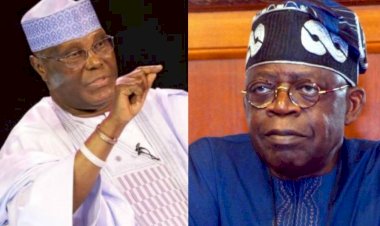
Former Vice President and presidential candidate of the African Democratic Congress (ADC), Atiku Abubakar, has said the latest Central Bank of Nigeria (CBN) Household Expectations Survey exposes the worsening economic hardship confronting Nigerians under President Bola Tinubu.
Atiku said the survey had contradicted the Federal Government’s claims of economic progress, arguing that Nigerians’ declining ability and willingness to purchase homes, vehicles and household goods showed that purchasing power was rapidly eroding.
He made the assertion in a statement issued at the weekend in Abuja by his Senior Special Assistant on Public Communication, Phrank Shaibu.
According to the CBN survey, buying conditions stood at 28.7 points for motor vehicles, 28.9 points for consumer durables and 30.0 points for buildings and landed property.
The survey also showed that willingness to purchase vehicles dropped to 18.7 points, while willingness to buy buildings and landed property stood at 19.2 points.
Reacting to the figures, Atiku said the data represented the views of Nigerian households rather than opposition propaganda.
“These are not figures manufactured by the opposition. They are the verdict of Nigerian households captured by the Central Bank under President Tinubu’s own government,” he said.
He argued that the situation was forcing families to devote most of their earnings to food, transportation, electricity, school fees and other basic necessities, leaving little room for savings, investment or acquisition of assets.
Atiku also cited the latest SBM Jollof Index, which put the average cost of ingredients for a pot of jollof rice for a family of five at N29,578. He said the amount represented more than 40 per cent of the N70,000 minimum wage.
The ADC candidate said the development made it difficult for ordinary Nigerians to meet basic needs, let alone improve their living standards.
He further criticised the Federal Government for celebrating macroeconomic indicators such as GDP growth and foreign reserves while households continued to struggle with rising living costs.
“Government officials can celebrate GDP growth, foreign reserves and other statistics from air-conditioned conference rooms, but ordinary Nigerians have become unwilling economists, calculating every cup of rice, every litre of fuel and every transport fare before deciding what their families can afford,” he said.
Atiku warned that weakening consumer purchasing power could also hurt businesses, production and employment, noting that reduced consumption would eventually affect the wider economy.
“An economy is not successful merely because government officials can quote favourable statistics. An economy succeeds when citizens can work, earn, eat, save, invest and progressively improve their standard of living,” he said.
He urged the Tinubu administration to focus on improving the purchasing power of Nigerians, insisting that economic growth would mean little if citizens could not afford basic necessities.
“Before there is GDP, there must be dinner. Before there is prosperity, there must be purchasing power,” Atiku said.
He added that the government should stop relying on what he described as “PowerPoint economics,” arguing that the true measure of the economy was the financial condition of the average Nigerian household.