Lawyers Alert, Benue Homeland Security move to replicate community policing initiative in four LGs
 admin
Sep 27, 2026 10:58
16
0
admin
Sep 27, 2026 10:58
16
0

By Johnson Arua
Lawyers Alert in collaboration with the Benue Homeland Security has commenced moves to replicate the People-Centred Public Safety (PCPS) Community Policing model in additional communities across the state.
The initiative is expected to establish Community Policing Committees (CPCs) in Yelewata in Guma Local Government Area, Ikovwe in Katsina-Ala, Ayele in Agatu, as well as Kwande Local Government Area.
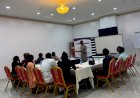
The development was disclosed at a Steering Committee meeting on the PCPS Community Policing Model held in Makurdi and organised by Lawyers Alert in collaboration with the Benue State Bureau of Homeland Security.
Speaking on the initiative, Lawyers Alert Advisor Legal, Solumtochukwu Ozobulu, said the meeting was aimed at strengthening coordination among stakeholders and preparing the ground for the expansion of the model.
She said the PCPS programme was launched by Governor Hyacinth Alia in February as a model for public safety in the state, adding that the decision to expand it was informed by the gains recorded through existing CPC structures in Guma and Katsina-Ala.
Ozobulu said, “The community members have been able to engage in dialogue, carry out sensitisation in collaboration with the security sector actors, and all these things. From the gains that have been garnered with this, we are working towards replicating this model.”
She explained that the CPCs were established as part of efforts to implement relevant provisions of the Police Act 2020, particularly Sections 113 to 117, which provide for community policing committees.
According to her, the committees bring together community members, traditional rulers, religious leaders, youths, women, persons with disabilities and security sector actors, including the police, Nigeria Security and Civil Defence Corps and the Benue State Civil Protection Guard.
She said the committees were designed to enable communities and security agencies to jointly identify security concerns, develop context-specific action plans and respond to emerging threats through dialogue, mediation, town hall meetings and early-warning mechanisms.
“The approaches that they usually take are dialogues, mediation, town halls, and most times they identify early warning signals in these communities,” she said.
Ozobulu added that accountability and human rights were central to the model, as the committees were expected to ensure that security personnel operated within the law and respected the rights of community members.
She said, “Very key to what they do is they ensure that security sector actors are accountable in their actions to the community. So they ensure that they work within the human rights ambit and they don't infringe on the rights of the communities.”
She further explained that the programme was designed to prevent situations from escalating to the point where kinetic security interventions became necessary.
“For us, it is important that security is framed from the perspective of the people, not just the perspective of anybody. What do they see safety as? How can they achieve that, which they consider safety in their environment?” she said.
According to her, the committees also consider issues including human trafficking, drug abuse, school safety and cult activities, with each community developing an action plan based on its peculiar security challenges.
She said the expansion to Kwande was particularly important given the security challenges, mining activities and herder-related conflicts in the area.
Ozobulu said trust between communities and security agencies remained critical to the success of the initiative, noting that “without trust we can't collaborate. So we need trust to be able to collaborate.”
She stressed that the initiative was guided by the principle that communities should be active participants in public safety rather than mere recipients of security interventions.
Earlier, Director-General of the Benue State Bureau of Homeland Security, Air Commodore Jacob Gbamwuan, said the experience from Guma and Katsina-Ala had demonstrated the value of structured platforms that bring communities, government institutions and security actors together.
Gbamwuan said the existing CPCs had helped stakeholders rebuild trust, improve communication and accountability, and strengthen early warning and response mechanisms.
“Community Policing Committees have provided an important link between communities and security institutions, allowing issues that may otherwise escalate to be identified and addressed through dialogue, information sharing and coordinated action,” he said.
He said the proposed replication in Yelewata, Ikovwe, Ayele and Kwande offered an opportunity to build on the lessons already learnt, while cautioning that replication should be adapted to the peculiar realities of each community.
“Replication, however, should not simply mean establishing structures in new locations. It should mean taking the lessons, good practices and challenges from the existing model and adapting them to the realities of each community,” Gbamwuan said.
He added that every community had its own security dynamics, actors, institutions and vulnerabilities, which must be considered in implementing the model.
The Director-General of the Benue State Bureau for International Cooperation and Development, BICD, Dr Leo-Angelo Viashima, commended the donors, civil society organisations and development partners supporting the initiative.
Viashima also urged security personnel attending the meeting to ensure that the outcomes were communicated to their superiors to promote continuity and institutional memory.
He said, “The discussions don't have to stay in this room. So beyond attending these meetings, please try to debrief your superiors who you are representing here.”
He expressed optimism that the initiative would provide a foundation for more effective community-based security arrangements in the state.
“As the country angles towards state policing, I believe that this will found some of the basic foundations that when state policing comes, Homeland Security will take leadership and we'll be able to have an effective system in place,” Viashima said.
The steering committee meeting brought together representatives of government institutions, security agencies, civil society organisations, development partners and members of existing Community Policing Committees among others.