ASUU Nsukka Zone warns FG: “Do not widen the trust deficit” over delayed 2009 Agreement
 admin
Nov 15, 2025 02:05
137
0
admin
Nov 15, 2025 02:05
137
0
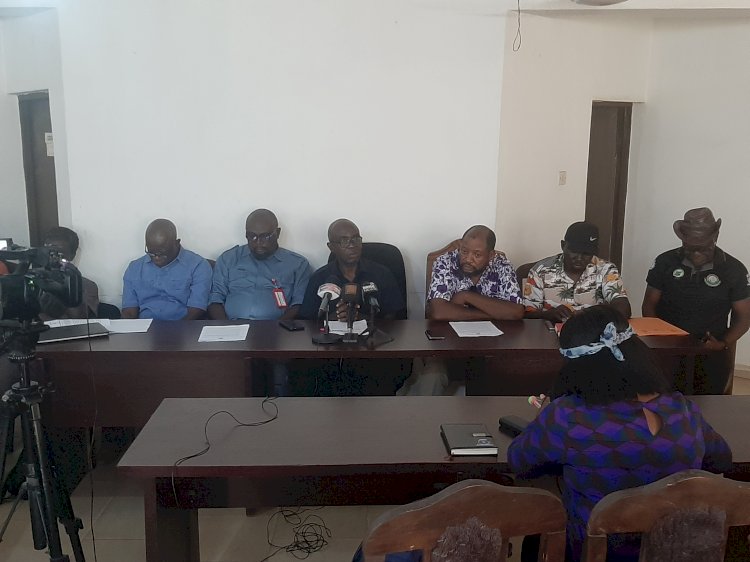
ASUU Nsukka Zone warns FG: “Do not widen the trust deficit” over delayed 2009 Agreement
By Benedicta Aboh
The Academic Staff Union of Universities (ASUU), Nsukka Zone, has accused the Federal Government of deliberately undermining the future of Nigeria by dragging its feet on the renegotiation of the 2009 ASUU-FG agreement, warning that the government risks widening the “trust deficit” between both parties if urgent action is not taken.
At a press conference held on at Benue State University, Makurdi, the zone comprising eight universities including
Academic Staff Union of Universities (ASUU- Nsukka Zone, made up of eight (8) universities, viz: Benue State University Makurdi, (BSU), Federal University of Agriculture, Makurdi (FUAM)), Enugu State University of Science and Technology (ESUT), Federal University of Health Sciences, Otukpo (FUSHO), Kogi State University (KSU), Federal University Lokoja (FUL), Federal University Wukari (FUW) and University of Nigeria, Nsukka (UNN)
said the government’s slow pace and alleged insincerity pose “grave dangers” to the nation’s education system.
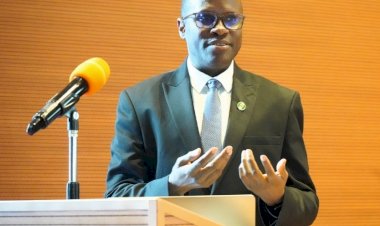
Zonal Coordinator, Comrade Christian Opata, said ASUU has spent over a decade negotiating the same issues with successive governments, only to be met with failed promises and half-hearted implementation.
“The Federal Government is deliberately killing the future of our nation through their lip service to the education sector,” Opata declared.
“Agreements were signed, timelines were given, but each time, the government brazenly jettisons them or implements only what it finds convenient.”
‘Insincerity forced strike actions’
Opata said it was the government’s inconsistency that pushed ASUU into nationwide press conferences and protest rallies in August 2025 to avert a strike, but even then, the Ministry of Education “chose propaganda over sincerity.”
He cited the minister’s conflicting statements as evidence of bad faith.
“How can the Minister say one moment that no agreement exists, and days later admit one does? How can he claim all ASUU’s demands have been met, yet we continue to hold meetings?” he queried.
Opata said the union suspended its recent warning strike out of respect for students, parents, the media and civil society groups who urged dialogue, believing that a one-month window was enough for genuine progress-if the government acted in good faith.
‘Government is not prioritising education’
However, following ASUU’s National Executive Council (NEC) meeting at Taraba State University last week, the union said it was disappointed by government’s failure to prioritise education.
The proposed salary increment on the table, ASUU noted, falls far short of addressing the conditions that continue to drive academics out of Nigerian universities.
“The proposed salary increase is a mere drop in the ocean,” Opata said.
“Worse still, it is below what the union rejected in 2022. Is government bereft of its own records, or is it simply buying time?”
He added that although some non-monetary issues are being resolved, salaries and conditions of service remain “a sore point requiring radical intervention.”
‘Stop misrepresenting facts’
ASUU also accused government officials of misrepresenting their actions, including what it described as tokenistic payment of long-overdue promotion arrears and release of third-party deductions.
“These are debts owed to our members for work long completed. They should not be framed as achievements,” Opata insisted.
“The government must stop trying to win the narrative and focus on solving the problem.”
‘Nigeria has the money, but not the will’
Contrary to claims of low revenue, ASUU said both federal and state governments have recorded significant increases in their revenue profiles in recent years.
Citing FAAC allocations, Opata noted that state revenues rose from N3.92 trillion in 2022 to N5.81 trillion in 2024, while federal revenues increased from N3.42 trillion to N4.65 trillion within the same period.
"It is not an economic problem. It is a political will problem,” he said.
“The numbers clearly show the government can fund education if it chooses to.”
‘Lecturers deserve a living wage’
The union called on traditional rulers, labour unions, students, parents and civil society organisations to intensify pressure on the government to conclude the renegotiation honourably.
“Our take-home can no longer take us home,” Opata lamented.
“A professor’s one-month salary cannot buy a return ticket from Lagos to Abuja. Senior lecturers cannot even afford publication fees for their research. This is unacceptable.”
ASUU warned that failure by the government to maximise the remaining days in the one-month negotiation window could plunge the university system into another avoidable crisis.
“The surest way to protect the future of our country is to invest in education. The government must not widen the trust deficit," Opata concluded.